A business introduction email tells a potential customer or partner who you are, why you are writing to them and what sensible next step you have in mind. It is a first conversation, not a company brochure. This guide covers introductions on behalf of a business, including cold outreach, referrals and partner introductions. If you need to introduce yourself to new colleagues at work, you will need a different message.
The smallest choice in an introduction can change the whole exchange. “We are a leading provider” asks the reader to believe a claim. “Your team is opening a new distribution channel; who handles partner onboarding?” gives them something they can answer. Use the eight templates below as structures, then replace every bracketed detail with a true one.
What Is a Business Introduction Email?
It is an email that establishes a business relationship or reconnects one. You might introduce your company to a prospect, introduce two potential partners, hand an account to a new manager or contact a distributor in a new market.
A cold introduction goes to someone who has not asked to hear from you. An event introduction follows an actual encounter. A referral names a person who genuinely agreed to make or be mentioned in the introduction. These differences matter: a message that claims a connection you do not have can damage trust before the reader reaches your offer.
An introduction may eventually lead to a sale, but its immediate job is smaller: help the reader decide whether a conversation is relevant. If you already have a detailed proposal, save it for the person who requests it.
How Do You Write an Introduction Email That Is Easy to Answer?
Use five parts, usually in this order:
1. Subject line: Name the real topic, person or context. Keep it consistent with the email.
2. Opening about the recipient: Mention one verified detail or the genuine reason you are connected.
3. One-sentence introduction: Say who you are and what your company does in ordinary language.
4. Relevant value: Connect that work to one task or decision the reader faces. Do not list every service.
5. One easy ask: Ask a question they can answer without preparing for a sales call.
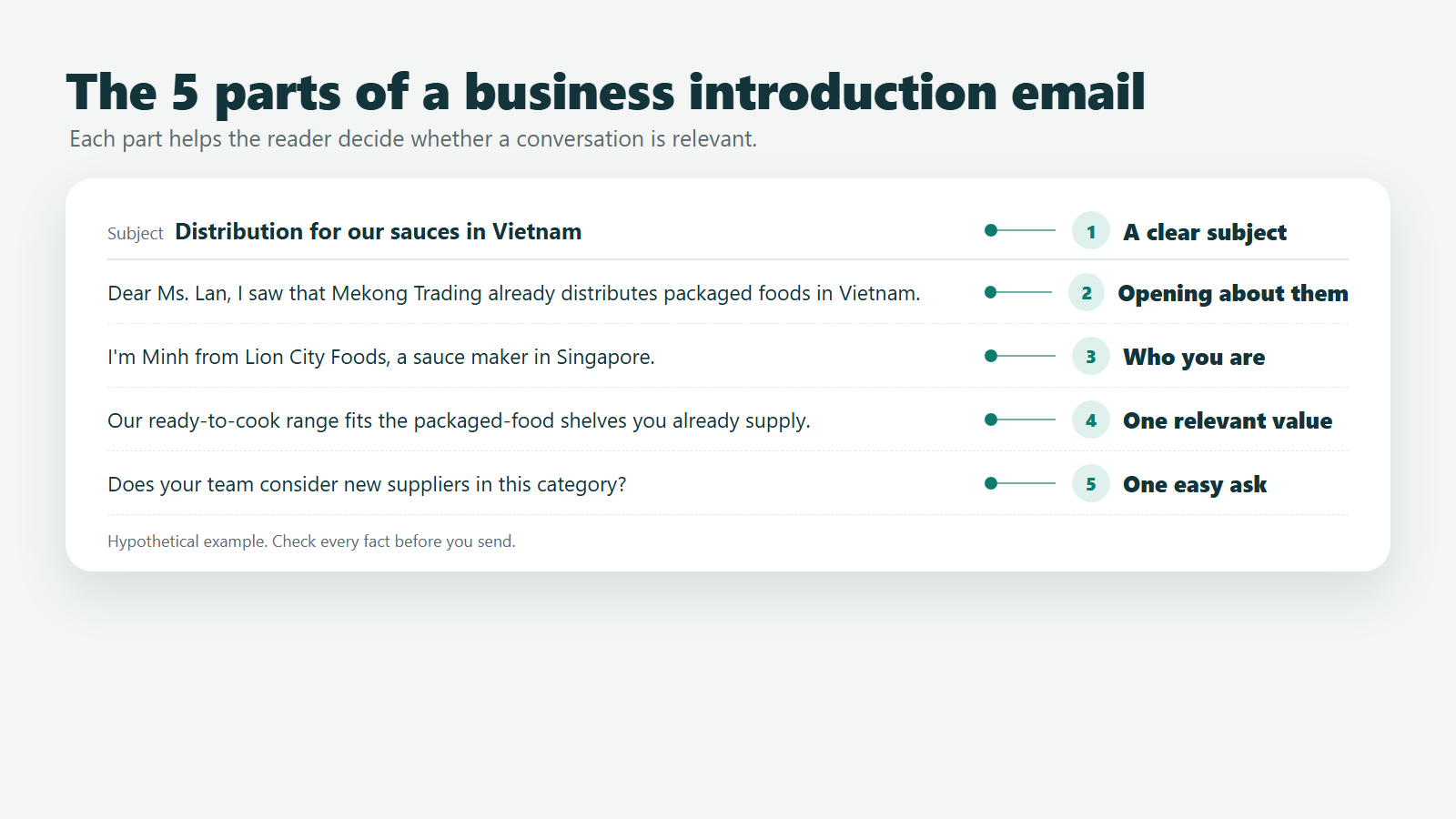
If a line could go unchanged to every prospect in your database, check whether it belongs in the email. You can add background later if the recipient wants it.
8 Business Introduction Email Templates With Matching Follow-Ups
The companies, services and situations below are illustrative. Send a follow-up only when appropriate, in the original thread, and stop if the recipient declines or opts out. The alternative subject gives you a second truthful angle to test; it is not a reason to send two introductions to the same person.
1. Introduce Your Company to a Cold Prospect
Use when: You can name a real reason the recipient’s company fits your offer, but you have no prior relationship.
Subject: A question about [process] at [Company]
Alternative: [Company] and [specific task]
First email
Hi [First name],
I saw that [Company] offers [verified service]. How does your team handle [related task] when [specific situation] occurs?
I’m [Your name] at [Your company]. We help [type of business] with [one concrete outcome]. Would a short example of that process be useful?
[Your name]
Follow-up
Hi [First name],
One practical step for [task] is to record [specific field or decision] before the work passes to another team. I can share a short example if that is relevant to you.
[Your name]
Why it works: It gives the reader a question about their work before asking them to evaluate your company.
2. Follow Up After Meeting at an Event
Use when: You really spoke with the person and can recall the topic. If you only attended the same event, say that instead of claiming a meeting.
Subject: Good to meet you at [event]
Alternative: Your question about [topic] at [event]
First email
Hi [First name],
Good to meet you at [event] on [day]. We spoke about [specific topic], especially [detail they raised].
I’m [Your name] from [Your company]. We work on [relevant service]. Would it help if I sent the [specific resource or answer] I mentioned?
[Your name]
Follow-up
Hi [First name],
I found the [resource] we discussed. The part on [specific section] addresses your question about [topic]. If it is still useful, I can send it over.
[Your name]
Why it works: It continues an actual conversation and makes the promised next step clear. Send the resource directly if you already promised to do so; do not withhold it just to obtain another reply.
3. Introduce Yourself Through a Referral
Use when: The referrer has agreed that you may use their name and has identified a relevant reason to connect.
Subject: [Referrer] suggested we speak about [topic]
Alternative: Introduction from [Referrer] — [topic]
First email
Hi [First name],
[Referrer] suggested I contact you about [topic] and said you are the right person to ask about [specific task].
I’m [Your name] at [Your company], where we help [type of business] with [relevant work]. Would you be open to a short exchange about how your team handles [task]?
[Your name]
Follow-up
Hi [First name],
To give you more context, the question I had was [one specific question]. If the timing is not right, I’m happy to leave it here.
[Your name]
Why it works: The referral explains the connection, while the question gives the recipient a choice. Never name someone simply because you know they are acquainted.
4. Introduce a New Account Manager
Use when: An existing customer’s main contact is changing. The customer needs continuity more than a sales pitch.
Subject: Your new contact at [Your company]
Alternative: Introducing [New manager] for your [account or project]
First email
Hi [First name],
I’m [New manager], and I’ll be your contact for [account or project] from [date]. [Previous manager] has shared the current priorities with me, including [accurate item you may mention].
You can reach me directly at [contact details]. Is there anything you would like me to review before our next scheduled update?
[New manager]
Follow-up
Hi [First name],
I’ve now reviewed [specific open item]. The next step on our side is [action] by [date]. Please let me know if a different priority needs attention first.
[New manager]
Why it works: It tells the customer who owns the work and what happens next. Check that the outgoing manager has actually transferred the records before saying so.
5. Introduce Your Company to a Potential Partner
Use when: You have a specific way the two businesses might work together, rather than a generic request to “explore synergies.”
Subject: A possible partnership around [specific customer need]
Alternative: [Your company] × [Partner company]: [project idea]
First email
Hi [First name],
I saw that [Partner company] supports [verified customer group or service]. Our team at [Your company] works on [complementary service].
One possible fit is [specific joint activity] for customers who need both. Does that overlap with the partnerships your team is considering?
[Your name]
Follow-up
Hi [First name],
A simple first test might be to map one customer situation where your [service] and our [service] meet. If that would be useful, I can outline the handoff and the responsibilities on each side.
[Your name]
Why it works: It gives the partner a concrete arrangement to assess without pretending that a partnership has already been agreed.
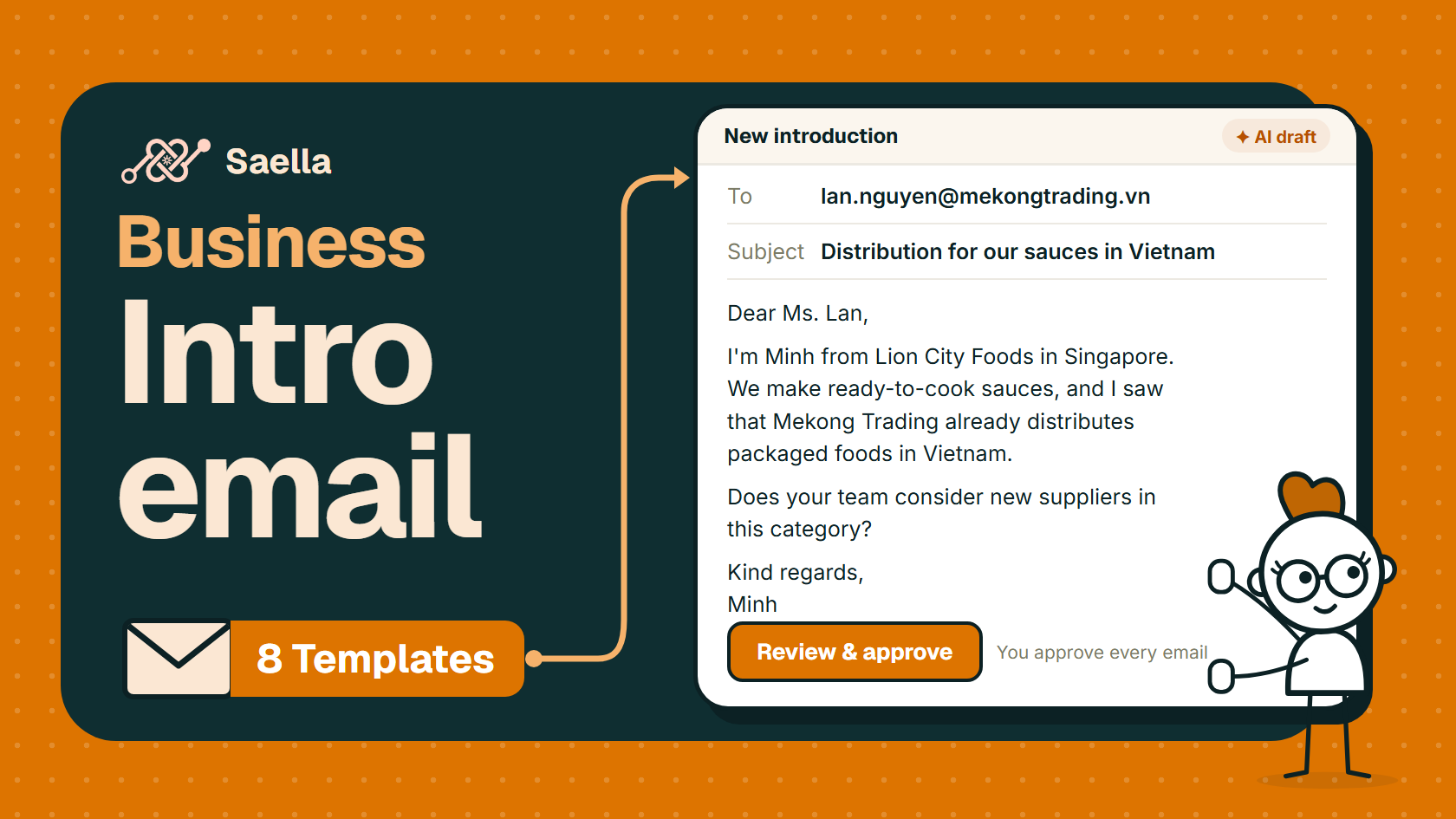
6. Introduce a Singapore Business to a Vietnam Distributor
Use when: Your business is entering Vietnam through a local distributor and you have checked the distributor’s actual product range.
Subject: Distribution discussion for [product category] in Vietnam
Alternative: [Singapore company] and [Distributor]: [product category]
First email
Dear [Name],
I’m [Your name] from [Singapore company]. We supply [specific product], and I saw that [Distributor] already works with [verified related category] in Vietnam.
We are assessing distribution partners for [defined product or channel]. Does your team consider new suppliers in this category?
Kind regards,
[Your name]
Follow-up
Dear [Name],
To make the question more specific, the initial range would cover [brief, accurate product scope]. If this is within your team’s remit, I can share the product sheet and discuss your evaluation process.
Kind regards,
[Your name]
Why it works: The recipient can decide whether the category fits before reviewing a long catalogue. Confirm product, market and import requirements separately before making commercial promises.
7. Introduce Two People to Each Other
Use when: Both people have agreed to the introduction. Tell each person why you think the connection is useful.
Subject: Introduction: [Person A] and [Person B] — [shared topic]
Alternative: Connecting you both about [specific project]
First email
Hi [Person A] and [Person B],
As agreed, I’m introducing you because [shared topic or concrete reason].
[Person A] leads [relevant role or work] at [Company A]. [Person B] works on [relevant role or work] at [Company B]. I thought a conversation about [specific subject] could be useful to both of you.
I’ll leave it to you to decide whether and when to connect.
[Your name]
Follow-up
Hi [Person A] and [Person B],
One more piece of context I forgot to include: [relevant detail both have agreed you may share]. I’ll step back and let you take it from here.
[Your name]
Why it works: It gives both people context and control. Do not send a routine chase to two people who have not asked you to manage their conversation.
8. Reintroduce Yourself to an Old Contact
Use when: You have a real previous connection, but enough time has passed that a reminder would help.
Subject: Reconnecting about [shared topic]
Alternative: [Event or project] and a new question
First email
Hi [First name],
We last spoke during [real event or project] about [topic]. Since then, I’ve been working on [relevant change at your company].
I thought of your team because [specific, current reason]. Is [topic] still something you handle at [Company]?
[Your name]
Follow-up
Hi [First name],
In case the role has changed since we spoke, the question is about [one-sentence description]. If it no longer sits with you, no action is needed.
[Your name]
Why it works: It refreshes the context without assuming the old relationship is still active or that the person still has the same role.
What Tone Works for Business Introductions in Southeast Asia?
Start with the individual and the company, not a rule about an entire country. Check the person’s preferred name and title rather than guessing from the name alone. A formal first note can be appropriate when approaching an unfamiliar distributor or senior executive; an existing contact may welcome a simpler tone. Follow their reply rather than forcing a script.
For cross-border messages, put a proposed meeting time in the recipient’s time zone and name the time zone explicitly. A Singapore sender and a Vietnam recipient are only one hour apart, but an unlabelled “3 p.m.” can still cause a missed call. Check local working days and holidays before scheduling a follow-up.
Keep the email in a language the recipient can comfortably use. If you cannot write a reliable translation, a clear English message may be better than a machine-translated note that misstates your offer.
Frequently Asked Questions
How long should a business introduction email be?
Include enough to answer who you are, why you chose this person and what you want them to do. The first email rarely needs a full company history, service list or pitch deck. If the next step is easy to understand without a paragraph, remove the paragraph.
Should an introduction email be formal or casual?
Match the relationship and context. Start respectfully with a new contact, then take cues from their response. Specificity matters more than sounding either unusually formal or unusually friendly.
How do I reply to an introduction email?
Thank the person who made the introduction, acknowledge the other person and suggest one next step. For example: “Thanks for connecting us, Minh. Hi Alex, your work on distributor onboarding sounds relevant to our current project. Would a 20-minute call next week be useful?” If you do not want to connect, a brief and courteous decline is enough.
Should I attach a brochure to the first email?
Only if the recipient asked for it or the document is necessary to evaluate the introduction. A short description and a relevant question usually give the reader a simpler first decision.
Prepare a Relevant First Introduction With Saella
The quality of an introduction depends on the group you choose and the facts you use, not the number of people you contact. Saella helps you select companies and draft first emails from available company information. Review the recipient, edit the claim and approve each email before sending it. Start with one audience and one reason to introduce your business.
Find your next customers in Southeast Asia
Start free