A B2B cold email introduces your business to someone who has not asked to hear from you. A good first message explains why you chose that person, offers a relevant idea and asks for one small next step. The 10 templates below cover common sales situations, including outreach to companies in Southeast Asia. Each one has a matching follow-up.
Use these as drafts, not as facts about a prospect. Check company details and adapt the offer before sending. Review your contact data, domain setup and applicable outreach rules in the markets where you operate.
What Makes a B2B Cold Email Worth Reading?
Start with a specific group of companies that could use what you offer. Then identify the right role, the reason to write now and a question that person can answer. A company name in the first line is not enough. The connection between your offer and their work needs to be clear.
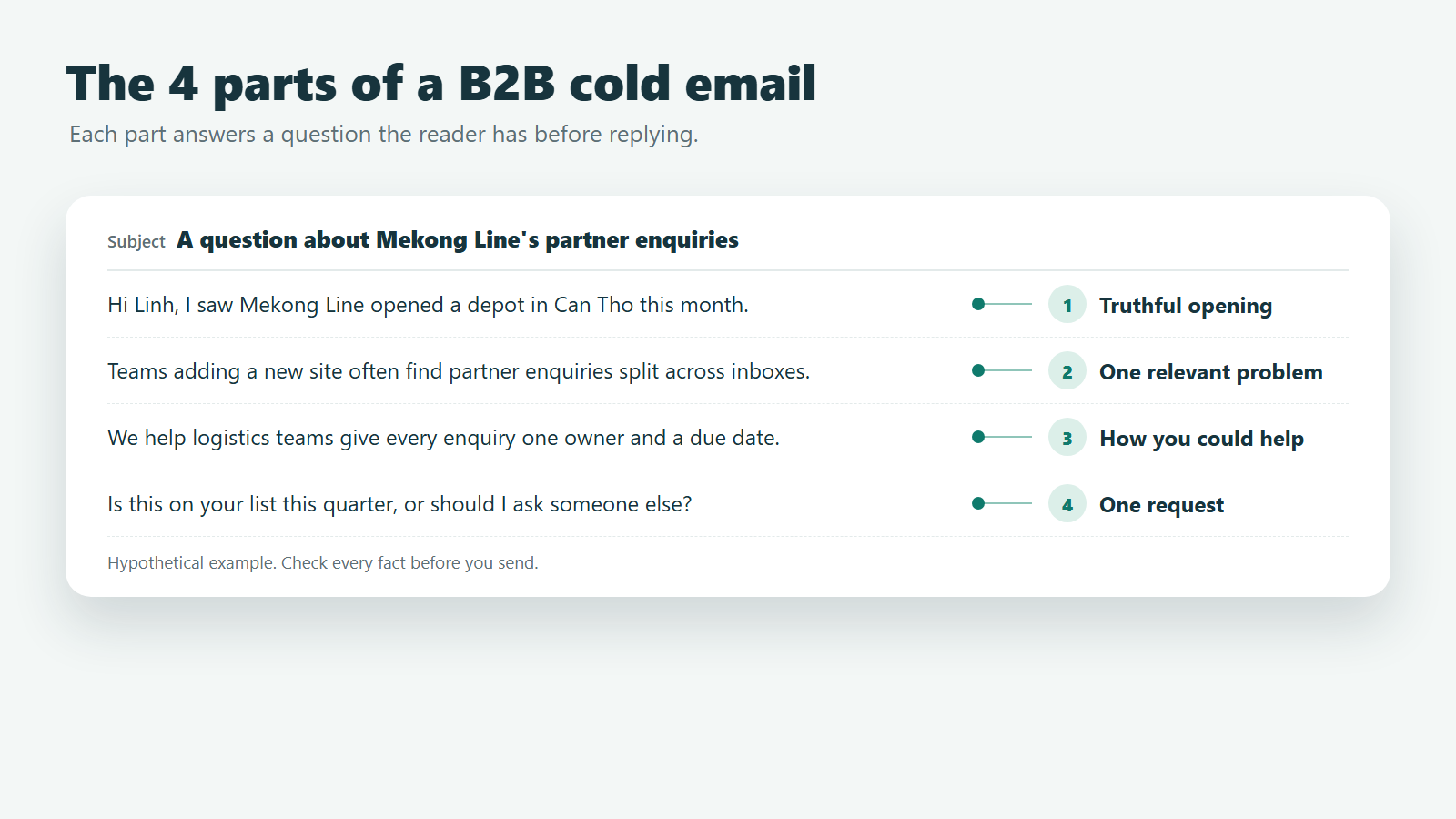
Most first emails need four parts: a truthful opening, one relevant problem or opportunity, a concise explanation of how you could help and one request. You can ask whether the topic is a priority, offer a short example or check whether you have reached the right person. Pick one.
A cold email differs from an unwanted blast in its preparation and conduct. Confirm that the recipient and topic are relevant, avoid misleading claims, identify yourself and make it easy for the person to decline. Stop contacting anyone who opts out. A template does not make an irrelevant campaign acceptable.
How Should You Personalize a Template?
Use details you can verify. Industry, country, company size, an announced expansion or a question from a prior public discussion may help you choose the angle. Do not claim to know the team's budget, pain points or plans from a database field alone.
For example, a company record may say that a distributor operates in Malaysia. That does not prove it wants new suppliers. You can ask whether expanding a specific product line is on its agenda, but you should not write, “I know you are struggling to find suppliers.” A short, accurate question is stronger than invented familiarity.
Before you send, read the first line and ask whether it could go to any company on your list. If it could, add a relevant reason or remove the line. Check the recipient's name, role and company. If the information is uncertain, avoid a claim that depends on it.
10 B2B Cold Email Templates With Matching Follow-Ups
Replace every bracket with a real detail. The first message starts the conversation; the follow-up adds a useful angle or makes the next step easier. Send a follow-up only if the original email was appropriate and the person has not declined or opted out.
1. Ask a Relevant Question
Use this when you have a clear topic but do not know the buyer's current process.
Subject: How does [company] handle [task]?
Hi [Name],
I work with teams that need to [specific outcome]. For [industry] companies, [task] can involve several owners.
How does your team handle [specific task] today? If this is a priority, I can share a short example of the approach we use.
[Your name]
Matching follow-up:
Hi [Name],
One way to make [task] easier to track is to assign an owner and next action to each request. Would a two-minute example be useful?
[Your name]
The question opens a conversation without pretending to know the answer. The follow-up gives a concrete idea.
2. Respond to a Verified Company Change
Use this only after checking a recent announcement and its date.
Subject: [Company]'s [new market or service]
Hi [Name],
I saw that [company] announced [specific change]. If it affects how your team handles [related task], our [service or process] may be relevant.
Are you reviewing that workflow as part of the change?
[Your name]
Matching follow-up:
Hi [Name],
Following up on [announced change]. A useful first check is [one practical question]. If that is on your team's list, I can send a short outline.
[Your name]
The announcement gives context, but it does not prove that the company needs your offer. Keep the link conditional.
3. Offer a Useful Resource
Use this when you have a genuinely relevant guide, checklist or example.
Subject: A short checklist for [task]
Hi [Name],
Teams entering [market] often need to check [specific issue] before they start outreach. We put together a short checklist covering [two relevant points].
Would you like me to send it?
[Your name]
Matching follow-up:
Hi [Name],
One item from that checklist may be useful: [accurate, actionable point]. If you are working on [task], I can send the full version.
[Your name]
Describe the resource accurately. Do not promise a guide that does not exist, and do not make the buyer book a call just to receive it.
4. Address a Common Process Problem
Use a problem common to the buyer's role, but present it as a possibility.
Subject: A question about [process]
Hi [Name],
When [process] involves several teams, it can be hard to see who owns the next step. We help [type of company] organize [specific part of the process].
Is this relevant to your team, or do you already have a clear workflow?
[Your name]
Matching follow-up:
Hi [Name],
A simple starting point is to record [owner] and [next action] for every [request or lead]. Would you like a sample layout?
[Your name]
This message names a possible issue. It also leaves room for the buyer to say that the issue does not apply.
5. Share a Verified Peer Example
Use this only when you have permission to share an accurate example. Remove identifying details if necessary.
Subject: An example for [type of team]
Hi [Name],
We helped [permitted customer description] with [specific task]. Their approach was [brief, factual detail].
Would a short summary be useful as you assess [related decision]?
[Your name]
Matching follow-up:
Hi [Name],
One useful part of that example was [verified detail]. I can share how the team chose that step, if it is relevant to your plans.
[Your name]
Do not invent a client, result or testimonial. If you cannot verify an example, use a hypothetical process example and label it clearly.
6. Find the Right Person
Use this when the company fits your audience but you are unsure who owns the decision.
Subject: Who handles [task] at [company]?
Hi [Name],
I am trying to reach the person who manages [specific task] at [company]. We help [type of team] with [one relevant outcome].
Is that you, or is there someone else I should contact?
[Your name]
Matching follow-up:
Hi [Name],
I wanted to check whether you handle [task]. If this is outside your role, a quick pointer would help. If not, I will leave it here.
[Your name]
Keep the request small. Do not imply that a colleague referred you unless they actually did.
7. Introduce an Offer for a Vietnam Logistics Company
This is a hypothetical example. Adapt the offer to the service you actually provide and verify the company's activities.
Subject: A question about [company]'s regional enquiries
Hi [Name],
I saw that [company] provides logistics services in Vietnam. If your team handles enquiries from several countries, keeping each request with the right owner may matter.
We help teams organize [specific workflow]. Would a brief example for regional enquiries be useful?
[Your name]
Matching follow-up:
Hi [Name],
For a regional enquiry, one useful step is to record the market, owner and next action together. Is that part of your current process?
[Your name]
Do not suggest that the company is losing enquiries. The email asks whether the workflow is relevant.
8. Contact a Malaysian Distributor About a Specific Fit
This is a hypothetical example. Make sure the product category and territory match the distributor's stated business.
Subject: [Product category] in Malaysia
Hi [Name],
I saw that [company] distributes [verified product category] in Malaysia. We offer [specific, compatible product or service] for [buyer type].
Is your team reviewing new options in this category, or should I contact someone else?
[Your name]
Matching follow-up:
Hi [Name],
A useful first check may be whether [one relevant requirement] fits your current range. I can send a short specification if you are reviewing this category.
[Your name]
Specific fit matters more than a broad claim that your product is “perfect” for the market.
9. Approach a Singapore Team Expanding Across Southeast Asia
This is a hypothetical example. Verify which markets the company actually serves.
Subject: Coordinating [task] across [markets]
Hi [Name],
I saw [verified information about the company's markets]. Teams working across countries sometimes need one view of [specific workflow].
We help with [relevant task]. Is your team looking at how to manage this across [markets]?
[Your name]
Matching follow-up:
Hi [Name],
One question worth settling is whether each market uses the same [process or criteria]. If useful, I can share a short comparison checklist.
[Your name]
Avoid treating a Singapore headquarters as proof that every Southeast Asian market is covered by the same team.
10. Reopen a Relevant Earlier Discussion
Use this if you truly spoke with the person or their team before. Name the earlier discussion accurately.
Subject: Revisiting [earlier topic]
Hi [Name],
We spoke in [month] about [specific topic]. At the time, [accurate reason for waiting] was the main consideration.
Has the timing changed, or would you prefer that I close this out?
[Your name]
Matching follow-up:
Hi [Name],
I will leave the earlier idea with you for now. If [topic] becomes a priority, you can reply here and I will send an updated outline.
[Your name]
Do not use a fake “Re:” line or claim a relationship that does not exist. If the contact already opted out, send nothing.
How Do You Prepare a Cold Email Campaign?
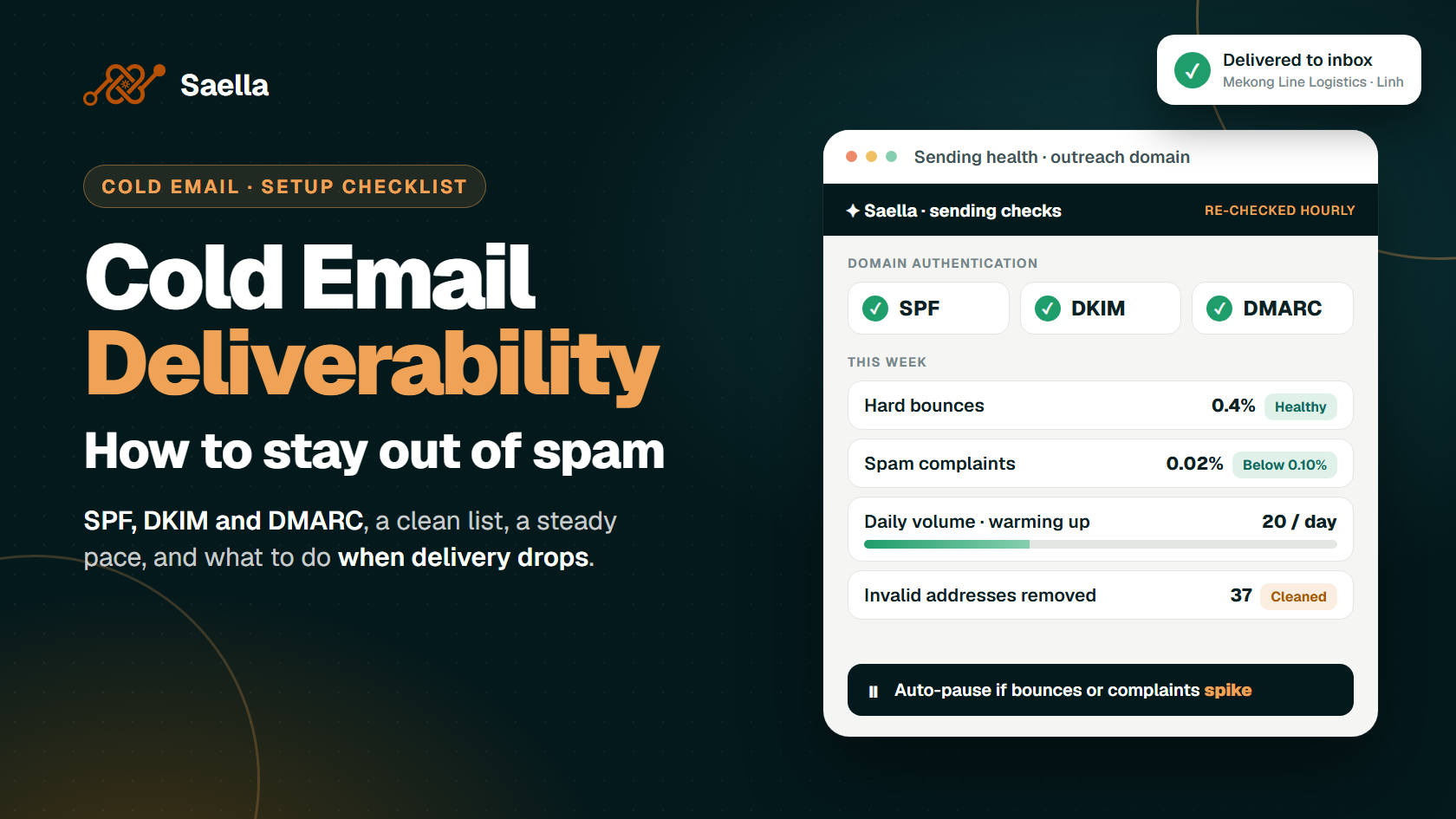
Start with a small, relevant group. Check each company's market, activity and reason to contact the chosen role. Review addresses before launch; invalid contacts cause bounces, while irrelevant messages can lead to complaints.
Set up your sending domain and check SPF, DKIM and DMARC. Gmail recommends these authentication methods and has additional requirements for high volume senders. Its email sender guidelines also cover spam rates and unsubscribe support. Yahoo's sender guidance emphasizes relevant messages, authentication and clear ways to unsubscribe. Follow the rules that apply to your sending volume and message type.
Send a small test before scaling. Review delivery errors, complaints and actual replies. Stop scheduled follow-ups when a recipient responds or opts out. Do not treat an open as proof that the person read your email; privacy features and security tools can affect tracking.
Saella can help select companies and draft outreach from available company information. Review the target, every factual claim and the proposed follow-up before you approve a send. The same first line should not appear in every message simply because a template made it easy to copy.
Frequently Asked Questions
How long should a B2B cold email be?
Keep the first message short enough to understand quickly. Give the reader a clear reason for the email and one action. A complex offer may need a little more context, but avoid adding a company history that does not help the decision.
How many follow-ups should I send?
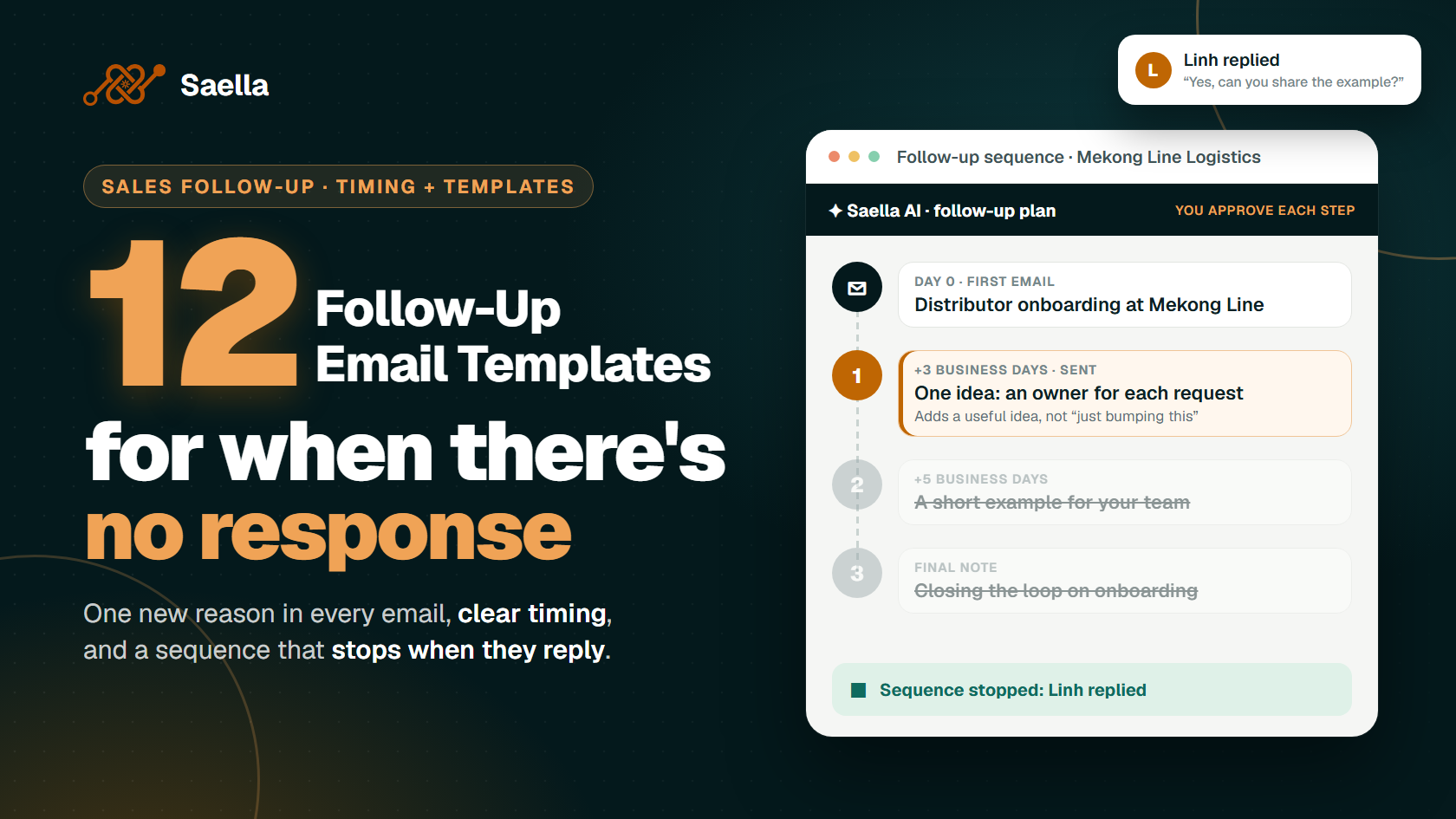
There is no universal number. Two or three useful follow-ups can be a starting test, with gaps between them. Stop on a reply, decline or opt-out. The companion guide on sales follow-up emails covers timing and situations in more detail.
Is cold email legal everywhere?
Rules differ by country, recipient, data source and message type. Check the requirements in the sender's and recipient's markets before sending. A business address or a public company listing does not by itself settle whether a campaign is allowed.
Should I use the same subject line for every prospect?
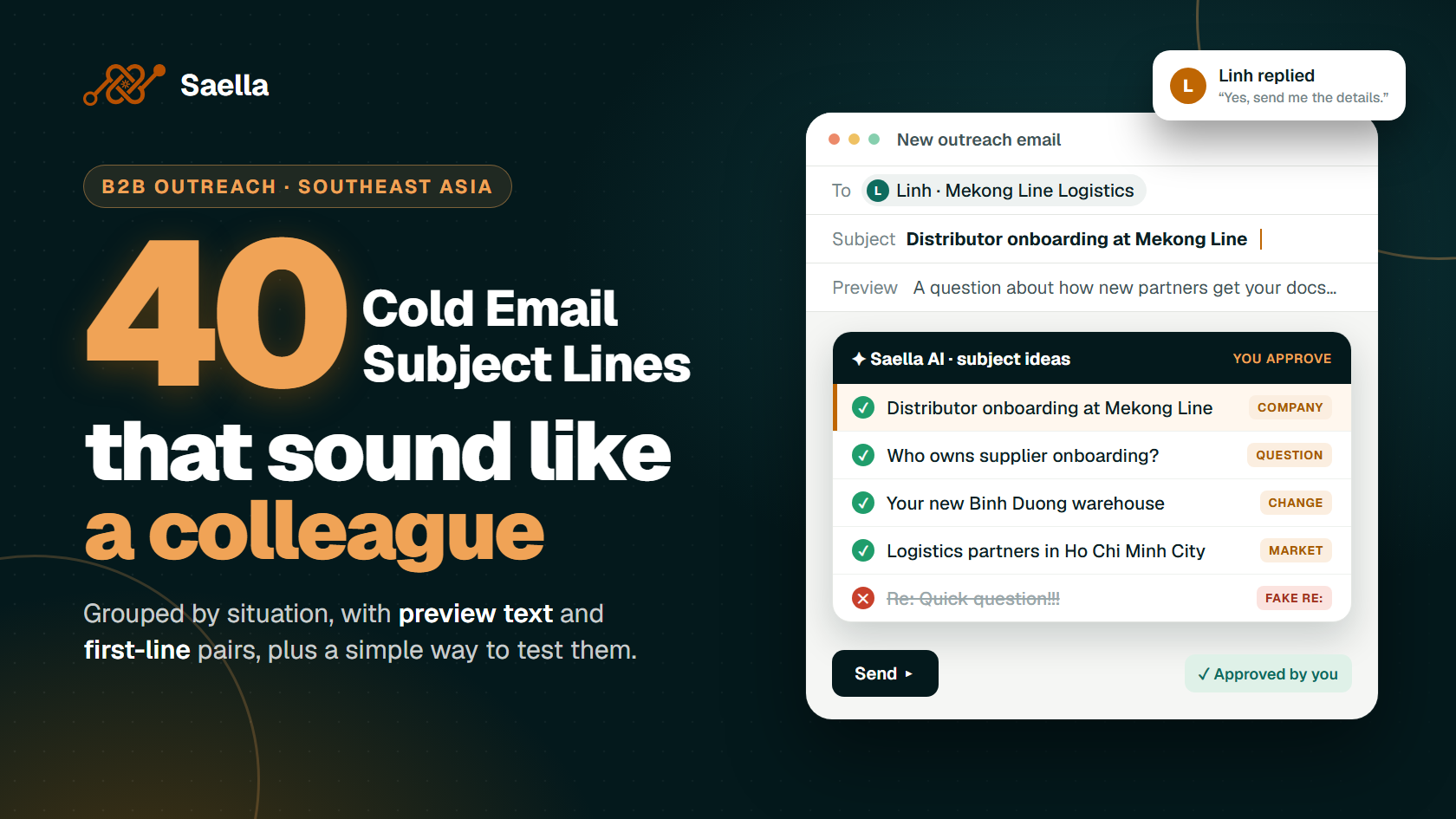
You can use a consistent structure, but check that each subject matches the email. Keep it clear and accurate. See the cold email subject line guide for more examples and testing advice.
Start With a Relevant Group in Saella
A template is only useful when the audience and reason to write are right. Saella helps you select companies, prepare outreach and plan follow-ups. Choose one group, check the available company data, edit the draft and approve the final message. Then use replies and delivery signals to improve the next group.
Find your next customers in Southeast Asia
Start free